
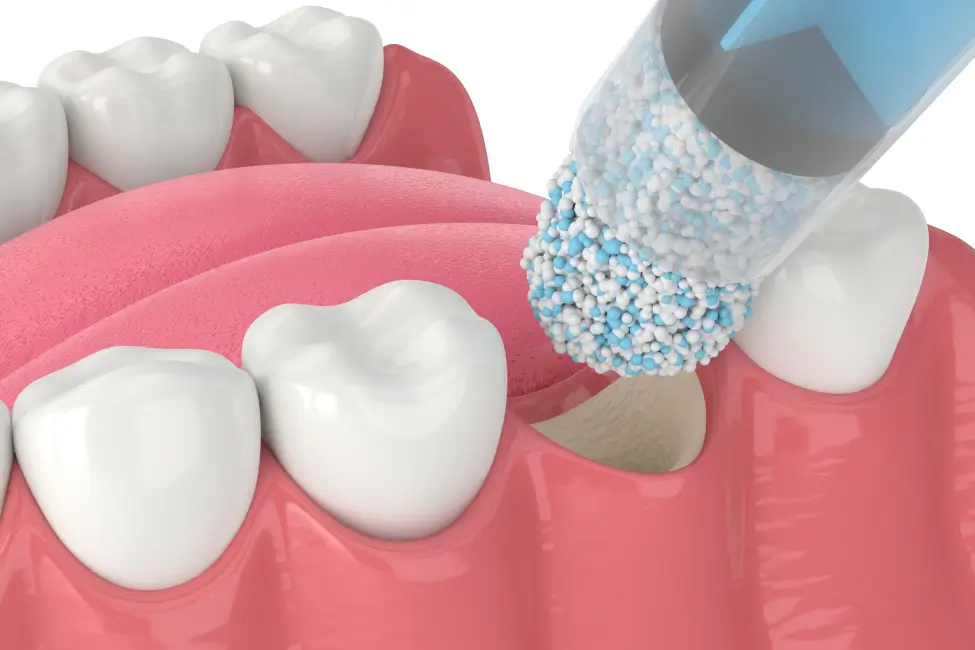
Why do dentists recommend bone regeneration before dental implants? Some patients are advised to have a bone graft prior to implant placement when bone is insufficient. To lay the best foundation for an implant, the jaw must have enough healthy bone to stabilize the implant (primary stability) and support long-term function.
Dentists sometimes recommend guided bone regeneration for this purpose. Bone grafting (often with a membrane, ”guided bone regeneration,” GBR) adds or rebuilds bone volume so an implant can be placed safely.
If you want to know more reasons why bone regeneration is a good option before dental implants, then keep on reading.
What Exactly is Bone Regeneration in Dental Procedures?
During a guided bone regeneration (GBR) procedure, your dentist places bone graft material in areas of the jaw where bone density is insufficient (width/height/quality). A protective membrane is then applied to guide the body’s natural bone growth. Over time, this process encourages new bone formation, repairs tissue, and creates a stable foundation for secure dental implant placement.
Why Your Dentist Might Recommend a Bone Graft
A dentist may ask you to get a bone graft or bone regeneration for the following reasons:
1. To Preserve Bone After a Tooth Extraction
After a tooth is removed, the jawbone in that area starts shrinking (resorbing).
Placing a small graft immediately after extraction helps preserve the ridge shape and volume for future restoration.
2. Strengthen the Foundation of Implant
If your jawbone isn’t thick or dense enough, it may not properly anchor a dental implant.
A bone graft strengthens the site, creating a solid foundation for long-term implant success.
3. Repair Bone Loss from Gum Disease or Infection
Serious gum disease or chronic infection can cause bone degradation. A graft rebuilds these lost areas, improving support for remaining teeth.
4. Preserve Facial Contours
When bone loss occurs, facial muscles lose support, leading to a “sunken” or aged appearance.
Bone grafting helps maintain natural facial shape and youthful contours.
5. Encourage Natural Bone Growth
Bone grafts serve as a scaffold for your body to regenerate new bone tissue over time by a process called guided bone regeneration (GBR). They rebuild deficient areas and help stabilize ridge shape. This supports long-term oral health and stability.
Depending on the location and extent of bone loss, your dentist may recommend one of several grafting techniques, such as socket preservation after extraction, ridge augmentation to rebuild thin areas of bone, or a sinus lift for implants in the upper back jaw.
What Happens in a Bone Regeneration Procedure Before Implants?
Bone regeneration is a complex yet effective procedure. When it comes to graft types, they may be autograft (your bone), allograft (donor human), xenograft (bovine/porcine), or alloplast (synthetic). A collagen or PTFE membrane is often used to guide bone growth.
Here is a short description of what happens in its procedure:
- Your dentist assesses the area using X-rays or 3D images
- Local anesthesia is administered to ensure comfort
- They place the graft and membrane in the missing area
- The site is sutured to protect it and encourage healing
- Discusses temporary tooth options if esthetics matter
- New bone forms typically over 3 to 6 months
- You have to return for periodic follow-ups so the dentist can monitor progress
Success is lower with smoking, uncontrolled diabetes, or poor oral hygiene; risks include infection, graft exposure/failure, sinus issues (for sinus lifts), and prolonged healing.
The Last Thought
Bone grafting is recommended when there is insufficient bone to support a dental implant. While the procedure might appear complex, it is a crucial step toward long-lasting dental implant success. It improves jaw strength, protects your investment in your smile, and improves facial aesthetics.
Schedule a consultation at Perio Health Professionals to determine if a bone graft fits your implant needs. You may call us today at (346) 509-9060 to schedule your appointment with our specialist.
