
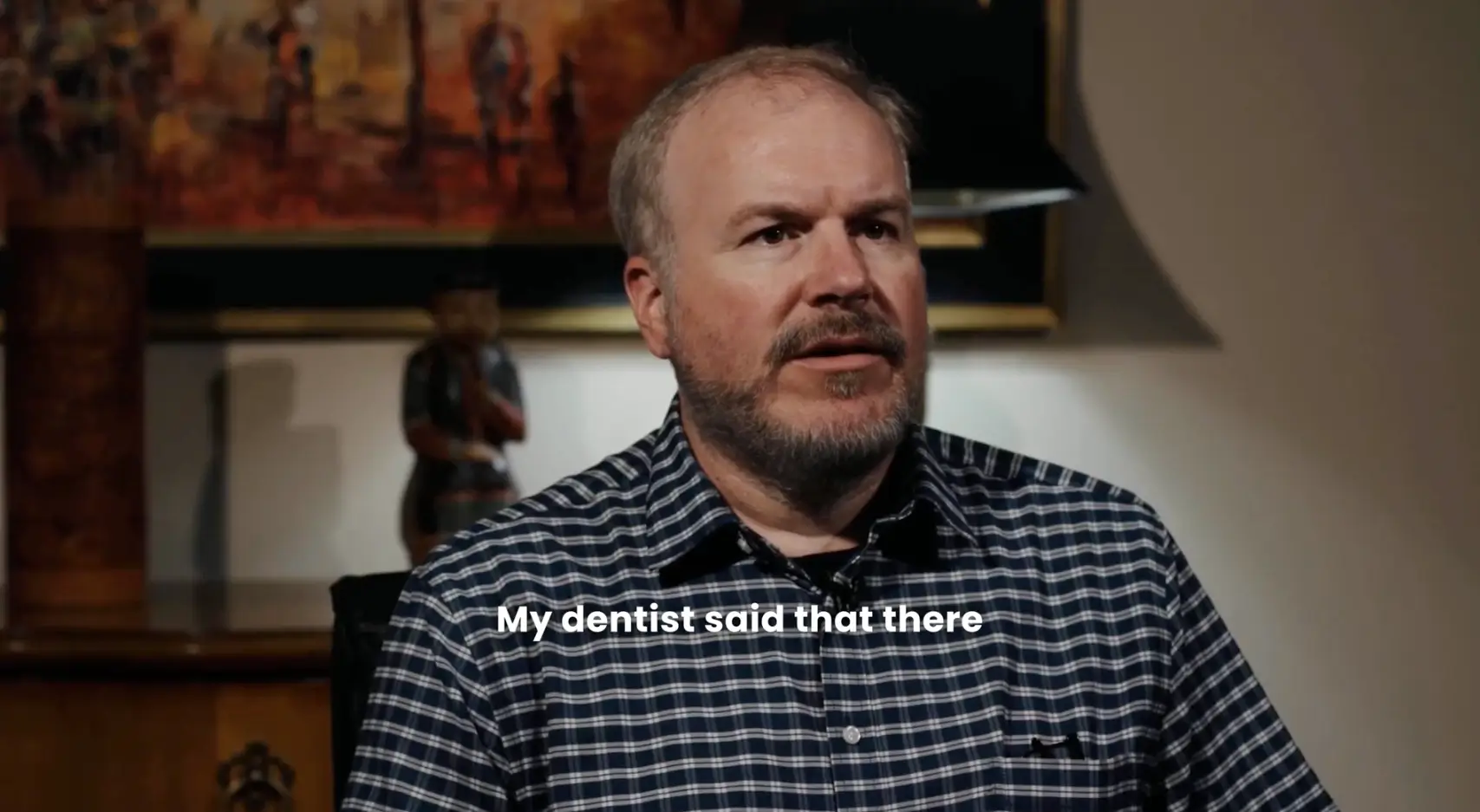
Scott Bonasso’s treatment involved three dental practices in the Houston area and a single structural diagnosis. His general dentists, Dr. Jaclyn Wedemeyer and Dr. Courtney Ellis, referred him to orthodontist Dr. Mike Mizell, who referred him to Dr. Michael K. McGuire at Perio Health Professionals. The cause of his shifting teeth was a narrow upper jaw, and correcting it required each clinician to hand the case forward at the right moment. This is a collaborative dental referral working as it should.
Why a Trusted Dental Referral Begins With the General Dentist
Over several years, Scott’s dental history changed. His teeth were moving out of alignment and he was developing caries more often than before. Each issue could have been treated in isolation. His general dentists, Dr. Jaclyn Wedemeyer and Dr. Courtney Ellis, recognised a pattern instead.
That assessment set the direction for everything that followed. Rather than restoring the teeth and monitoring, the practice recognised a pattern that pointed to a structural cause and referred Scott for an orthodontic evaluation. It is the kind of decision that rarely appears in a chart note, yet it is where the outcome was decided.
Orthodontic Referral to a Periodontist: Treating the Jaw Before the Teeth
Orthodontist Dr. Mike Mizell could have begun treatment. Scott’s teeth could be aligned with braces, and he said so. He also said something else.
“He looked at my teeth and said, ‘I can straighten your teeth for you with braces, but I think there’s an even more underlying problem with the structure of the top part of your jaw.’”
Aligning teeth within a constricted maxilla treats the position of the teeth, not the reason they moved. Dr. Mizell recognised that the skeletal base had to be addressed first, and that this fell within periodontal and surgical expertise rather than orthodontics alone. He referred Scott to Dr. McGuire before placing a single bracket.
A clinician with a viable treatment in hand deferred it, because a colleague could resolve the underlying problem and make the orthodontic result more predictable. That judgement is the referral relationship at its best.
Diagnosing a Narrow Upper Jaw: MARPE Palatal Expansion at Perio Health Professionals
At Perio Health Professionals, Dr. Michael K. McGuire’s examination confirmed what both referring practices had suspected. Scott’s upper jaw (maxilla) was narrow and out of proportion to the lower jaw. Combined with bruxism, that transverse discrepancy explained the shifting teeth and the recurring problems that had brought him in.
The treatment plan was MARPE palatal expansion. MARPE (miniscrew-assisted rapid palatal expansion) is an appliance anchored to the roof of the mouth with small titanium screws, activated gradually to widen a narrow upper jaw in adult patients. In Scott’s case it was placed with a surgical release along the bone and expanded over the following months. He describes the first days after placement as significant, and the adjustment period as short.
Only once the maxilla had been expanded did orthodontic treatment begin. The teeth were then aligned within a properly proportioned arch, which was the sequence Dr. Mizell had anticipated from the start. The appliance was removed after approximately one year.
Scott’s account of the process is consistent with what referring doctors tell us they value most: a plan that is explained clearly and carried out as described.
“The plan and the procedure were very clearly explained. He’s a compassionate doctor that cares a lot about his patients. He’s a nice man, an expert in his field.”
Completing the Circle of Care With Houston’s Referring Doctors
Scott is now approximately three months from completing orthodontic treatment. His most recent visit was back where the case began, with his general dentist.
“For the first time in years I had a dentist appointment where there were zero issues.”
That appointment is the measure of the referral. The patient returned to the practice that first identified the problem, with the problem resolved. The restorative and hygiene work ahead is simpler because the structural cause is gone.
Why the Dental Referral Process Matters
Scott’s case is one example of a process that protects patients and practices alike. A referral made at the right moment delivers three things that no single practice can deliver on its own.
The correct diagnosis, reached sooner. Each clinician in this case saw the problem from a different vantage point. The general dentist saw the pattern, the orthodontist saw its limits, and the periodontist identified its cause. A patient who moves through that sequence is diagnosed by three perspectives rather than one.
Treatment in the right order. Restorative work on teeth that are still moving, or orthodontics within an arch that is too narrow, produces results that are harder to maintain. Referring before treating gives each discipline a stable foundation to work on, and makes the referring doctor’s own work more predictable.
A patient who returns. A specialist referral is not a transfer of the patient. Perio Health Professionals treats the referred condition and returns the patient to the referring practice for ongoing care, with the plan explained at each stage. The referring doctor keeps the relationship, and the patient keeps a home practice that knew when to bring in help.
For general dentists and orthodontists, the practical case for referral is therefore not only clinical. It is a more predictable outcome, a stronger patient relationship, and a colleague who takes on the part of the case that falls outside their discipline.
Perio Health Professionals thanks Dr. Jaclyn Wedemeyer, Dr. Courtney Ellis and Dr. Mike Mizell. Each recognised the limits of what a single discipline should attempt in this case, and each referred at the right point in the sequence. Scott’s outcome belongs to all three practices as much as to ours.
The strongest outcomes in dentistry rarely come from one chair. The right referral is itself an act of excellent care, and it is the foundation of the circle of care we build with every referring doctor in Houston.